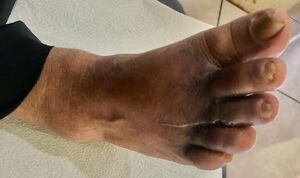
Case study: Chronic venous insufficiency of the right foot treated successfully with CDS + DMSO
Background and presentation: 79‑year‑old woman, housewife, obese, with hypertension and long‑standing type 2 diabetes and a sedentary lifestyle. On 18 Aug 2022 she stepped on a nail in the plantar surface of her right foot. The wound became infected and, after 16 days without effective care, she developed severe pain, marked swelling and a deep plantar ulcer. Hospital angio‑CT showed virtually absent blood flow to the right foot and extensive venous damage. The vascular team recommended amputation above the knee. Conventional care at that hospital did not produce improvement; the patient declined amputation and sought an alternative.
Intervention and rationale: after voluntary discharge she received chlorine dioxide solution (CDS) combined with dimethyl sulfoxide (DMSO), administered topically to the lesion and orally according to the treating team’s protocol (Protocolo K). The combined approach aimed to reduce local microbial burden, facilitate tissue penetration via DMSO and support restoration of microcirculatory function.
Clinical course and outcomes: on arrival to the clinic the foot contained coagulated blood and showed almost no distal perfusion. Following drainage of the coagulum and initiation of CDS+DMSO, a clear and sustained turnaround began. Within three weeks the patient had striking clinical improvement: pain and edema were substantially reduced and a weak distal pulse became palpable. Over the next months the wound showed progressive granulation and re‑epithelialization; at three months weak venous circulation was evident, at four months perfusion and tissue quality continued to improve, and by five months the plantar ulcer had greatly healed and limb viability was preserved. Importantly, the severe trajectory predicted by standard care — immediate amputation — was averted.
Interpretation: in this case, conventional hospital care failed to restore perfusion or resolve the infection and the clinical team recommended amputation. The addition of CDS+DMSO was followed by rapid clinical benefit, progressive tissue repair and recovery of detectable distal blood flow, resulting in limb salvage. The temporal relationship and the magnitude of improvement after initiating CDS+DMSO support a meaningful positive treatment effect in this patient.
Limitations: this is a single uncontrolled case and lacks quantitative serial vascular indices, detailed dosing records, and full information on concurrent therapies or metabolic control. Nevertheless, the outcome—avoidance of amputation after failure of standard hospital management—is clinically significant and warrants further systematic study.
Conclusion: for this elderly diabetic patient with an infected ischemic plantar ulcer judged unsalvageable by standard vascular care, adjunctive treatment with CDS+DMSO coincided with rapid symptom relief, progressive wound healing and restoration of distal perfusion, enabling limb preservation. The case highlights potential therapeutic value of CDS+DMSO when conventional approaches are ineffective and supports the need for formal clinical evaluation.
Case study: Successful treatment of chronic venous insufficiency and infected plantar ulcer with CDS + DMSO — Testimony Dr. Jorge Ponce (Honduras)
Patient and timeline
Patient: 79‑year‑old woman, housewife, obese, history of hypertension (HTA) and type 2 diabetes (DM II), sedentary lifestyle.
Injury: 18 August 2022 — stepped on a nail with the right foot (plantar surface).
Early course: over the following days the wound became infected; no medical care was sought initially.
Worsening and hospital presentation: 3 September 2022 (16 days after the injury) — foot became markedly swollen, very painful, and a plantar ulcer formed. She was taken to the emergency unit (HEU) and underwent a venous angio‑CT of the lower limbs.
Hospital recommendation: the angio‑CT showed severely reduced blood flow to the right foot and extensive venous damage. The vascular surgeon recommended amputation of the right lower limb due to deficient perfusion. During this hospital stay she was diagnosed with type 2 diabetes.
Patient decision: the patient refused amputation and signed out of the hospital seeking alternative treatment.
Intervention
After voluntary discharge the treating team started a combined protocol of chlorine dioxide solution (CDS) plus dimethyl sulfoxide (DMSO).
Treatment included drainage of coagulated blood from the wound, topical application of CDS+DMSO to the lesion and oral administration according to the team’s protocol (Protocolo K). Exact doses and schedule were not specified in the source.
Clinical course and outcomes
Initial clinic status: on arrival at the clinic the foot showed coagulated blood in the wound and virtually absent distal blood flow.
Short‑term response (≈3 weeks): after drainage and initiation of CDS+DMSO the patient showed marked clinical improvement — substantial reduction in pain and edema and the emergence of a weak palpable distal pulse.
Intermediate follow‑up (3 months): weak but detectable venous circulation was present; the ulcer showed progressive granulation.
Continued recovery (4 months): perfusion and tissue appearance continued to improve with ongoing healing.
Later outcome (5 months): the plantar ulcer had significantly healed, tissue quality improved and distal perfusion was better; the limb was preserved and amputation avoided.
Interpretation
Standard hospital management (as applied during the initial HEU stay) did not restore perfusion or resolve the infectious process and resulted in a recommendation for amputation. After initiation of CDS+DMSO combined with local drainage and wound care, the patient experienced rapid symptomatic relief, progressive wound healing and restoration of detectable distal blood flow, enabling limb salvage.
The temporal association and the magnitude of clinical change after starting CDS+DMSO in a case where conventional care had been judged ineffective support a clinically meaningful positive outcome for this patient.
Limitations
Single case report without controls.
No detailed, objective serial vascular measures provided (e.g., ankle‑brachial index, quantitative Doppler, transcutaneous oxygen pressures).
Dosing, exact administration schedule, concurrent systemic antibiotics or other therapies, and glycemic control details were not available.
Causality cannot be definitively established; drainage and comprehensive local care, improved metabolic control or natural healing may have contributed.
Conclusion
In this elderly diabetic patient with an infected plantar ulcer and critical reduction of distal perfusion initially considered unsalvageable by hospital vascular teams, adjunctive CDS+DMSO therapy was followed by rapid clinical improvement, progressive wound healing and recovery of distal perfusion, avoiding the amputative outcome recommended earlier. This favorable single‑case result suggests potential benefit of CDS+DMSO in selected refractory limb infections/ischemia but underscores the need for standardized protocols, complete reporting and controlled clinical studies to confirm efficacy and safety.
Authorship
Case reported by Dr. Jorge Ponce (Honduras).
Prepared summary by Andreas Ludwig Kalcker (Dr. h.c.).